
Summers by the River with Grandmother Emma

By Chip Taylor

Chip Taylor is Founder and Director of Monarch Watch and Emeritus Professor of Ecology and Evolutionary Biology at the University of Kansas. Trained as an insect ecologist, Chip’s research projects have included studies of reproductive isolating mechanisms in sulfur butterflies, life history patterns in plants, demography and migratory behavior of monarch butterflies, and comparative biology of European and Neotropical African honeybees and African killer bees. In this feature, Chip reflects on his connection to nature, and how his appreciation of the natural world developed.

Credit: Chip Taylor

Chip Taylor, Founder and Director of Monarch Watch and Profenor of Ecology and Evolutionary Biology at the Univenity of Kansas

Credit: Broni Likomanov

Peshtigo River, Crivitz, Wl.

Credit: Broni Likomanov

7 year-old “Little Chippy” with 10 lb. snapping turtle. Peshtigo River, Crivitz, Wl.1944 )

I’ve seen it several times over the years but can’t find it now: it’s a picture of me, a smiling, skinny seven-year-old in a bathing suit. I’ve always wondered about that photo; I was proudly holding a ten­ pound snapping turtle by the tail as high as I could. How did I know how to catch and hold a snapping turtle at age seven?

I remember being told as a child that if you were bitten by a snapping turtle, it wouldn’t let go until sundown, even if you cut off its head. I had no idea whether or not that was true, but the lesson was clear: stay away from the head. The tail was a good handle, as the snapper couldn’t reach around to bite you. Applying that lesson to other wildlife-even porcupines-also seemed to work well for me. I became something of a barehanded porcupine catcher. I learned all this and discovered my nature connection when I spent summers with my grandmother, Emma Wasmund, at her 80-acre property near Crivitz, Wisconsin.

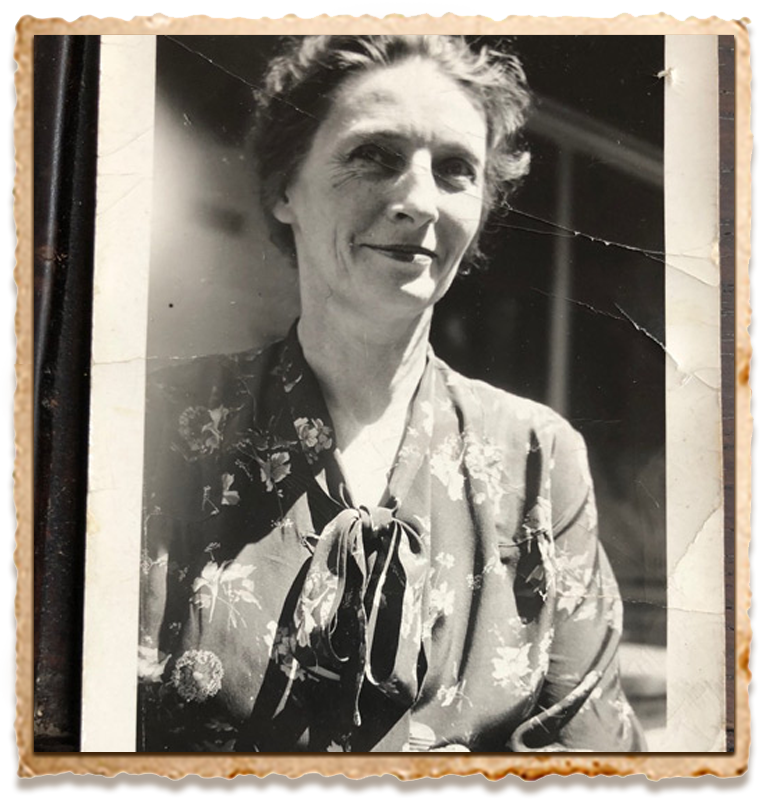
The three summers I spent with my grandmother and my cousins were formative. Grandmother was a special person. She embodied nature, and at some time in her life had acquired an amazing amount of lore about the natural world. At six to eight years old, I wasn’t able to distinguish between lore and knowledge, but I was fascinated. Grandmother was undoubtedly the source of the snapper advice. She also told me that if you were able to pick up a skunk by the tail, it wouldn’t spray you-nearly two decades later, I found baby skunks in an alfalfa field while doing field work outside of Dodge City, Kansas. The first skunk I picked up didn’t spray. The second didn’t get the memo, leading to a desperate search for a source of tomato juice. I guess I can give her credit for being correct half the time.

The three summers I spent with my grandmother and my cousins were formative. Grandmother was a special person. She embodied nature, and at some time in her life had acquired an amazing amount of lore about the natural world. At six to eight years old, I wasn’t able to distinguish between lore and knowledge, but I was fascinated. Grandmother was undoubtedly the source of the snapper advice. She also told me that if you were able to pick up a skunk by the tail, it wouldn’t spray you-nearly two decades later, I found baby skunks in an alfalfa field while doing field work outside of Dodge City, Kansas. The first skunk I picked up didn’t spray. The second didn’t get the memo, leading to a desperate search for a source of tomato juice. I guess I can give her credit for being correct half the time.

Another bit of wisdom involved snakes. She related that if you killed a snake during mating season, the grieving mate would find its way to you at night to get its revenge. I remembered that when I was fifteen. While wandering on a neighbor’s property late in the spring, I came across the biggest snake I had ever seen. I was a hunter and collector of sorts at that point in my life, so I killed it. It was while I was skinning the snake (a 5’5″ bullsnake) that I remembered what my grandmother had said. What if she was right? My brother and I were staying in a cabin with no plumbing, and we had to get up at night to relieve ourselves outdoors. What if the snake’s mate was nearby? I decided to return to the site where the snake was found, and unbelievably, the mate was there. She met the same fate as her suitor. I didn’t want to worry about stepping outdoors in the middle of the night!

Credit: Chip Taylor

Emma Wasmund 1892 -1959

Grandmother was right about the snakes, or so I thought; that may have led me to foolishly pick up those baby skunks fifteen years down the road. I later felt guilty about killing the snakes, but kept their skins hanging from the wall for 50 years: they were (and are} part of my story. I don’t kill snakes now, and I haven’t for many, many decades.
That snapping turtle from my first nature encounter came from the Peshtigo River, a shallow waterway that ran through the property. The river teemed with life: minnows of many kinds, crayfish, mud puppies under the rocks, three types of turtles, snails, and mussels of many sizes. Twice I found clusters of finger-length worm-like creatures that I couldn’t identify or catch. I spent hours in that river. It was my teacher.

“This river of life called to me, and it connected me to many rivers later in life: the St. Croix, the Mississippi, the Kansas, the Kenai, the East River in Colorado, and the Verdigris in Kansas.”

Credit: Chip Taylor

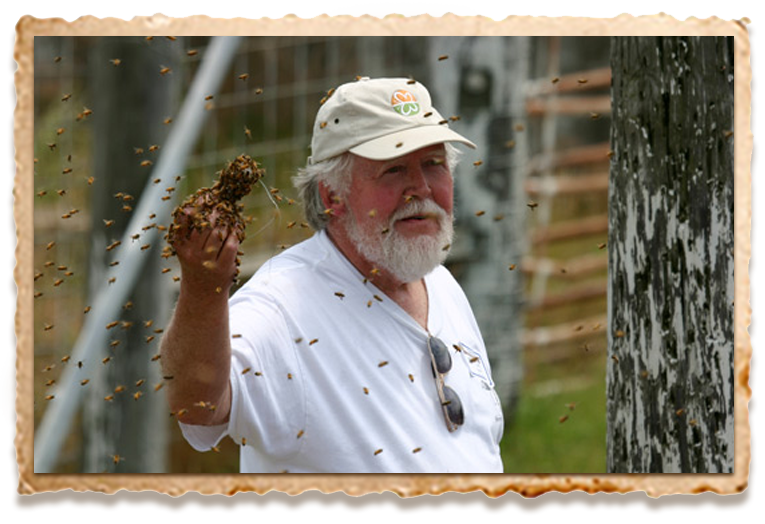
Teaching honeybee swarming biology at Northeast Kansas Beekeepers Fun Days

Credit: Chip Taylor

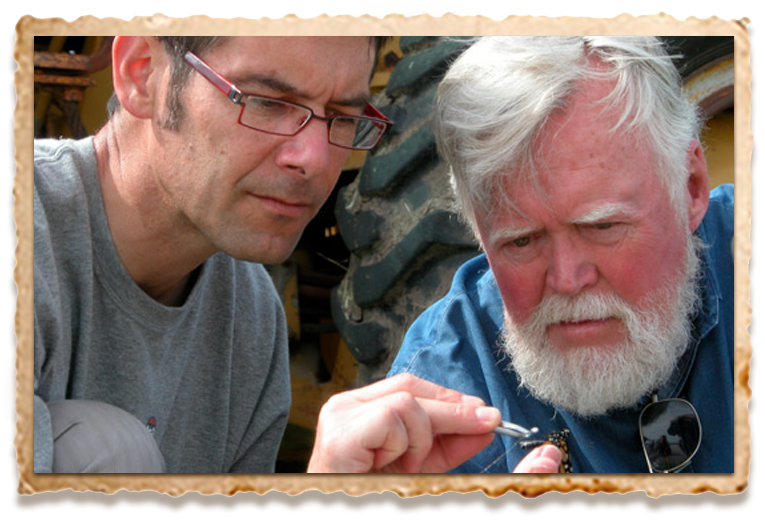
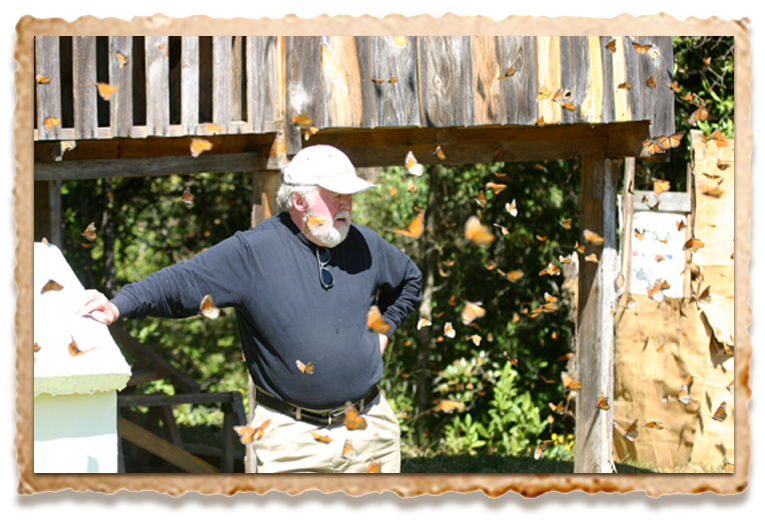
Martin Wikelski and Chip Taylor applying radio tag to monarch known as “Big Boy” to track migration

I learned what lived under which rocks in that river. The mudpuppies were few and were only found under large rocks with a cavity on the downriver side. Certain mussels could be found wedged between small stones, while others preferred sandy bottoms. The crayfish with their claws and egg masses glued to the underside of the abdomen were fascinating in their unique ability to move backwards.

I never found any Native American artifacts in the river, but there are surely some. Grandmother’s property had been a campground for woodland tribes hundreds of years in the past, before Europeans arrived and before metal was widely used. There were burial mounds on the property, and arrowheads were regularly found when nearby fields were plowed. Some of the artifacts found on the property made it to a museum in Chicago.

The prospect that people lived on that land before houses fascinated me. How did they stay warm in the winter? What did they eat? I couldn’t process it all at the age of eight, but it is clear now why woodland tribes lived there from time to time. The river was a source of food and water, and there were five species of berries and hazelnuts in great abundance on the property. There was even a four-acre pond in those days in which they may have grown wild rice. Relative to the more barren lands nearby, this was a good place to live. This exposure I had in my youth led me to an interest in Native Americans, and later in life the opportunity to work with numerous tribes.
Grandmother cooked on a wood stove, and food was maintained in an icebox that held big blocks of ice. The food was nothing fancy but was adequate for us growing children. Visiting adults would complain from time to time, but knew they had to eat what Grandmother offered, or they might be thrown in the river. Most got the message, but not Aunt Marge, who (over loud protests) was dragged down to the river and forced into the shallow water after refusing to eat what was served at the dinner table. The river wasn’t deep enough to throw anybody into it, yet the threat of being disciplined in this manner meant that little went to waste at that table. I didn’t escape Grandmother’s discipline, but I was never thrown into the river.
Grandmother introduced me to insects. We marveled at the luna and sphinx moths that came to the lights and at the shimmering colors of the damsel flies along the river. There were milkweed plants and monarchs. In her two gardens, there was an abundance of potato beetles, who seemed to spend an inordinate amount of time as couples, and tomato hornworm larvae whose coloration and shading were so good at the art of camouflage that the best way to find them was to follow the trail of the leaves that had been eaten. One of my chores was to patrol the garden with a coffee can in hand, into which I placed these unwanted insects for disposal. I wasn’t fond of that.
There was one thing we begged for as kids: Mr. Chilcote’s comb honey. Mr. Chilcote was a neighbor whose farm my grandmother would visit from time to time to purchase eggs, dressed chickens, and fresh comb honey in July. For me, this wasn’t just honey-it represented something that seemed impossible. The honey came in small square dovetailed basswood boxes. The honeycomb fit edge-to-edge with paperwhite wax cappings. I wondered how Mr. Chilcote get the bees to put the honey in the boxes!
One day, while visiting the Chilcotes with my grandmother, my curiosity drove me to tentatively approach the bee colonies, hoping that I could learn something about the bees and those boxes with honeycombs. Mr. Chilcote, ever-vigilant, saw me through the kitchen window. He came to the back door, and in a firm and scolding voice, told me to get away from the bees. I obeyed, but in my eight-year-old mind, he told me to get away because he didn’t want me to know his secret.

Credit: Chip Taylor

Chip Taylor and Monarch Watch

Chilcote’s Secret lingered in my mind along with the memory of that fine basswood and sweet clover comb honey, and I just had to know. So, when I was thirteen, I read every book about honeybees in the St. Paul Public Library, then built my first beehive. The following spring, I installed my first package of bees in that hive. That was exciting and successful, though it led to many failed attempts to get the bees to fill those basswood boxes with honey. Still, I learned a lot; later in life, the knowledge acquired in my pursuit of Chilcote’s Secret allowed me to dive into research on African bees (killer bees) in the Americas, along with many collaborative projects on honeybee mating behavior.
In college, I took courses in aquatic biology and never encountered such a life form as the clusters of worm-like creatures I found under rocks in the river as a youth. Decades later, while reading about sea lampreys in the Great Lakes, I realized what they were: sea lamprey larvae (ammocoetes). My observation as a youth in 1945 means that I may have been the first to have seen evidence of sea lampreys in that region, and if not that region, certainly that watershed.
Grandmother Emma’s love of nature and the opportunities and lessons she provided were formative for me. My discoveries during those summers under Grandmother Emma’s care-from insects, monarchs, and honeybees, to wildlife, rivers, and the history of Native American habitation­connected me with nature and would become a guiding influence in both my professional and personal life.

Thanks, Grandmother.

For more information about Chip Taylor and his work, visit Monarch Watch.

Summers by the River with Grandmother Emma

By Chip Taylor
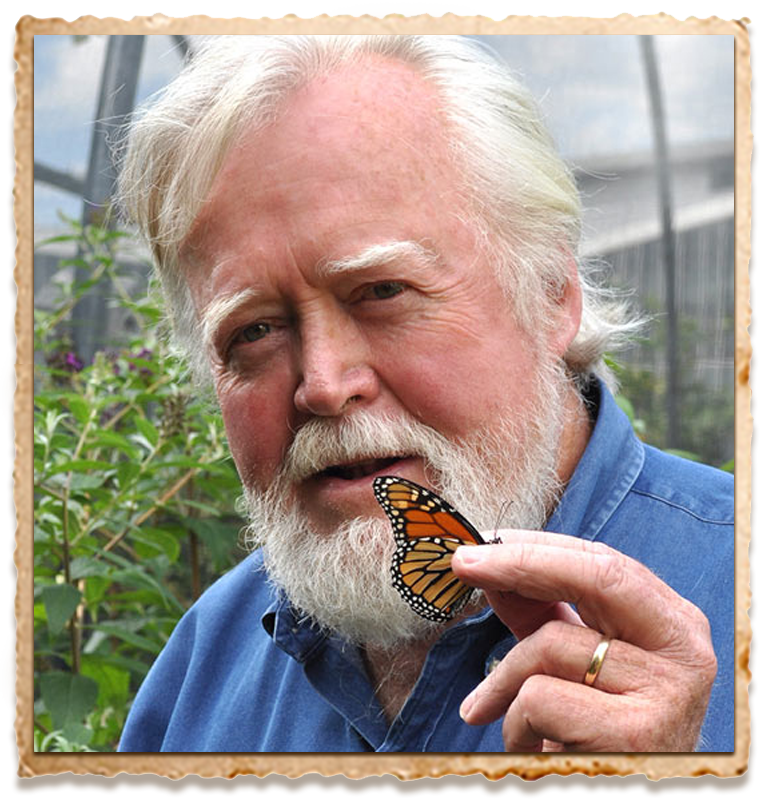
Chip Taylor is Founder and Director of Monarch Watch and Emeritus Professor of Ecology and Evolutionary Biology at the University of Kansas. Trained as an insect ecologist, Chip’s research projects have included studies of reproductive isolating mechanisms in sulfur butterflies, life history patterns in plants, demography and migratory behavior of monarch butterflies, and comparative biology of European and Neotropical African honeybees and African killer bees. In this feature, Chip reflects on his connection to nature, and how his appreciation of the natural world developed.

Credit: Chip Taylor

Chip Taylor, Founder and Director of Monarch Watch and Profenor of Ecology and Evolutionary Biology at the Univenity of Kansas
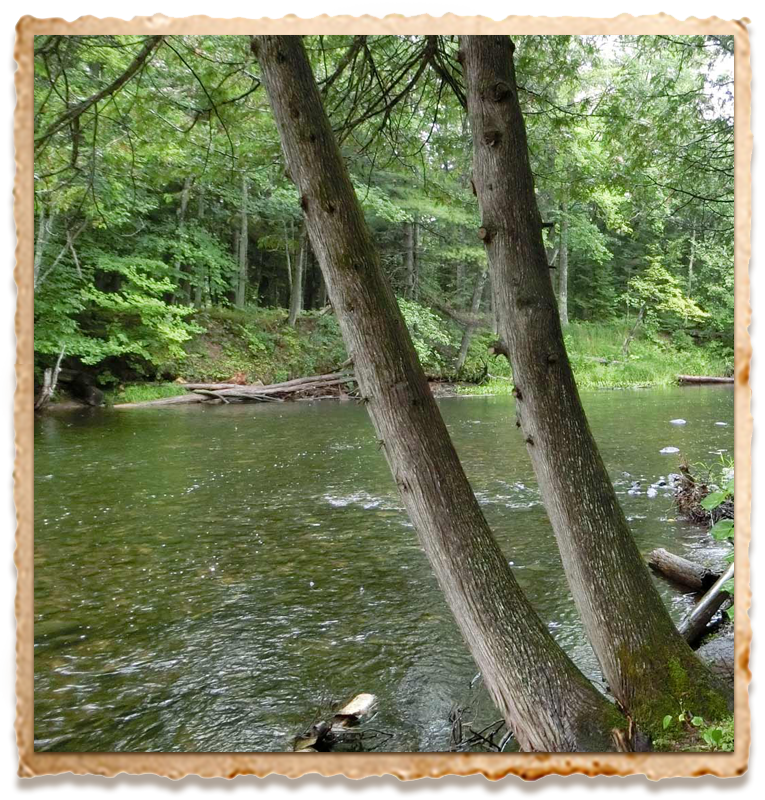
Credit: Broni Likomanov

Peshtigo River, Crivitz, Wl.
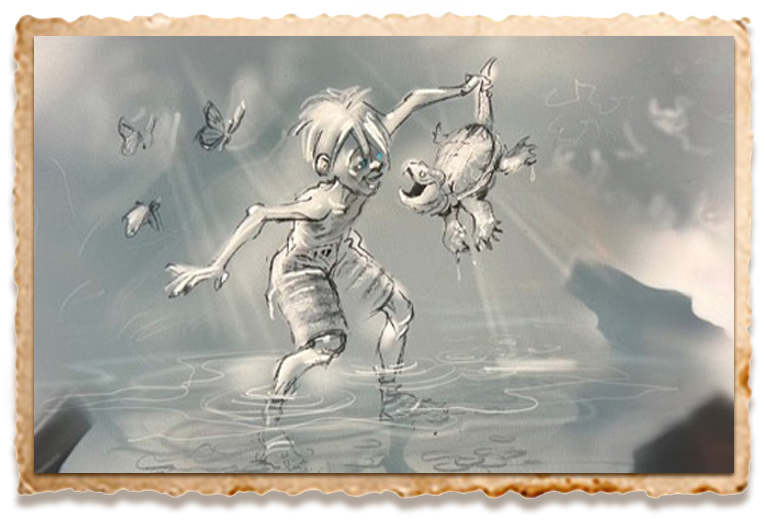
Credit: Broni Likomanov

7 year-old “Little Chippy” with 10 lb. snapping turtle. Peshtigo River, Crivitz, Wl.1944 )

I’ve seen it several times over the years but can’t find it now: it’s a picture of me, a smiling, skinny seven-year-old in a bathing suit. I’ve always wondered about that photo; I was proudly holding a ten­ pound snapping turtle by the tail as high as I could. How did I know how to catch and hold a snapping turtle at age seven?

I remember being told as a child that if you were bitten by a snapping turtle, it wouldn’t let go until sundown, even if you cut off its head. I had no idea whether or not that was true, but the lesson was clear: stay away from the head. The tail was a good handle, as the snapper couldn’t reach around to bite you. Applying that lesson to other wildlife-even porcupines-also seemed to work well for me. I became something of a barehanded porcupine catcher. I learned all this and discovered my nature connection when I spent summers with my grandmother, Emma Wasmund, at her 80-acre property near Crivitz, Wisconsin.

The three summers I spent with my grandmother and my cousins were formative. Grandmother was a special person. She embodied nature, and at some time in her life had acquired an amazing amount of lore about the natural world. At six to eight years old, I wasn’t able to distinguish between lore and knowledge, but I was fascinated. Grandmother was undoubtedly the source of the snapper advice. She also told me that if you were able to pick up a skunk by the tail, it wouldn’t spray you-nearly two decades later, I found baby skunks in an alfalfa field while doing field work outside of Dodge City, Kansas. The first skunk I picked up didn’t spray. The second didn’t get the memo, leading to a desperate search for a source of tomato juice. I guess I can give her credit for being correct half the time.

The three summers I spent with my grandmother and my cousins were formative. Grandmother was a special person. She embodied nature, and at some time in her life had acquired an amazing amount of lore about the natural world. At six to eight years old, I wasn’t able to distinguish between lore and knowledge, but I was fascinated. Grandmother was undoubtedly the source of the snapper advice. She also told me that if you were able to pick up a skunk by the tail, it wouldn’t spray you-nearly two decades later, I found baby skunks in an alfalfa field while doing field work outside of Dodge City, Kansas. The first skunk I picked up didn’t spray. The second didn’t get the memo, leading to a desperate search for a source of tomato juice. I guess I can give her credit for being correct half the time.

Another bit of wisdom involved snakes. She related that if you killed a snake during mating season, the grieving mate would find its way to you at night to get its revenge. I remembered that when I was fifteen. While wandering on a neighbor’s property late in the spring, I came across the biggest snake I had ever seen. I was a hunter and collector of sorts at that point in my life, so I killed it. It was while I was skinning the snake (a 5’5″ bullsnake) that I remembered what my grandmother had said. What if she was right? My brother and I were staying in a cabin with no plumbing, and we had to get up at night to relieve ourselves outdoors. What if the snake’s mate was nearby? I decided to return to the site where the snake was found, and unbelievably, the mate was there. She met the same fate as her suitor. I didn’t want to worry about stepping outdoors in the middle of the night!
Credit: Chip Taylor

Emma Wasmund 1892 -1959
Grandmother was right about the snakes, or so I thought; that may have led me to foolishly pick up those baby skunks fifteen years down the road. I later felt guilty about killing the snakes, but kept their skins hanging from the wall for 50 years: they were (and are} part of my story. I don’t kill snakes now, and I haven’t for many, many decades.
That snapping turtle from my first nature encounter came from the Peshtigo River, a shallow waterway that ran through the property. The river teemed with life: minnows of many kinds, crayfish, mud puppies under the rocks, three types of turtles, snails, and mussels of many sizes. Twice I found clusters of finger-length worm-like creatures that I couldn’t identify or catch. I spent hours in that river. It was my teacher.

“This river of life called to me, and it connected me to many rivers later in life: the St. Croix, the Mississippi, the Kansas, the Kenai, the East River in Colorado, and the Verdigris in Kansas.”
Credit: Chip Taylor

Teaching honeybee swarming biology at Northeast Kansas Beekeepers Fun Days
Credit: Chip Taylor

Martin Wikelski and Chip Taylor applying radio tag to monarch known as “Big Boy” to track migration

I learned what lived under which rocks in that river. The mudpuppies were few and were only found under large rocks with a cavity on the downriver side. Certain mussels could be found wedged between small stones, while others preferred sandy bottoms. The crayfish with their claws and egg masses glued to the underside of the abdomen were fascinating in their unique ability to move backwards.

I never found any Native American artifacts in the river, but there are surely some. Grandmother’s property had been a campground for woodland tribes hundreds of years in the past, before Europeans arrived and before metal was widely used. There were burial mounds on the property, and arrowheads were regularly found when nearby fields were plowed. Some of the artifacts found on the property made it to a museum in Chicago.
The prospect that people lived on that land before houses fascinated me. How did they stay warm in the winter? What did they eat? I couldn’t process it all at the age of eight, but it is clear now why woodland tribes lived there from time to time. The river was a source of food and water, and there were five species of berries and hazelnuts in great abundance on the property. There was even a four-acre pond in those days in which they may have grown wild rice. Relative to the more barren lands nearby, this was a good place to live. This exposure I had in my youth led me to an interest in Native Americans, and later in life the opportunity to work with numerous tribes.
Grandmother cooked on a wood stove, and food was maintained in an icebox that held big blocks of ice. The food was nothing fancy but was adequate for us growing children. Visiting adults would complain from time to time, but knew they had to eat what Grandmother offered, or they might be thrown in the river. Most got the message, but not Aunt Marge, who (over loud protests) was dragged down to the river and forced into the shallow water after refusing to eat what was served at the dinner table. The river wasn’t deep enough to throw anybody into it, yet the threat of being disciplined in this manner meant that little went to waste at that table. I didn’t escape Grandmother’s discipline, but I was never thrown into the river.
Grandmother introduced me to insects. We marveled at the luna and sphinx moths that came to the lights and at the shimmering colors of the damsel flies along the river. There were milkweed plants and monarchs. In her two gardens, there was an abundance of potato beetles, who seemed to spend an inordinate amount of time as couples, and tomato hornworm larvae whose coloration and shading were so good at the art of camouflage that the best way to find them was to follow the trail of the leaves that had been eaten. One of my chores was to patrol the garden with a coffee can in hand, into which I placed these unwanted insects for disposal. I wasn’t fond of that.
There was one thing we begged for as kids: Mr. Chilcote’s comb honey. Mr. Chilcote was a neighbor whose farm my grandmother would visit from time to time to purchase eggs, dressed chickens, and fresh comb honey in July. For me, this wasn’t just honey-it represented something that seemed impossible. The honey came in small square dovetailed basswood boxes. The honeycomb fit edge-to-edge with paperwhite wax cappings. I wondered how Mr. Chilcote get the bees to put the honey in the boxes!
One day, while visiting the Chilcotes with my grandmother, my curiosity drove me to tentatively approach the bee colonies, hoping that I could learn something about the bees and those boxes with honeycombs. Mr. Chilcote, ever-vigilant, saw me through the kitchen window. He came to the back door, and in a firm and scolding voice, told me to get away from the bees. I obeyed, but in my eight-year-old mind, he told me to get away because he didn’t want me to know his secret.

Credit: Chip Taylor

Chip Taylor and Monarch Watch

Chilcote’s Secret lingered in my mind along with the memory of that fine basswood and sweet clover comb honey, and I just had to know. So, when I was thirteen, I read every book about honeybees in the St. Paul Public Library, then built my first beehive. The following spring, I installed my first package of bees in that hive. That was exciting and successful, though it led to many failed attempts to get the bees to fill those basswood boxes with honey. Still, I learned a lot; later in life, the knowledge acquired in my pursuit of Chilcote’s Secret allowed me to dive into research on African bees (killer bees) in the Americas, along with many collaborative projects on honeybee mating behavior.
In college, I took courses in aquatic biology and never encountered such a life form as the clusters of worm-like creatures I found under rocks in the river as a youth. Decades later, while reading about sea lampreys in the Great Lakes, I realized what they were: sea lamprey larvae (ammocoetes). My observation as a youth in 1945 means that I may have been the first to have seen evidence of sea lampreys in that region, and if not that region, certainly that watershed.
Grandmother Emma’s love of nature and the opportunities and lessons she provided were formative for me. My discoveries during those summers under Grandmother Emma’s care-from insects, monarchs, and honeybees, to wildlife, rivers, and the history of Native American habitation­connected me with nature and would become a guiding influence in both my professional and personal life.

Thanks, Grandmother.

For more information about Chip Taylor and his work, visit Monarch Watch.